DEC Issues Air Quality Alert Extended Through Midnight Tuesday
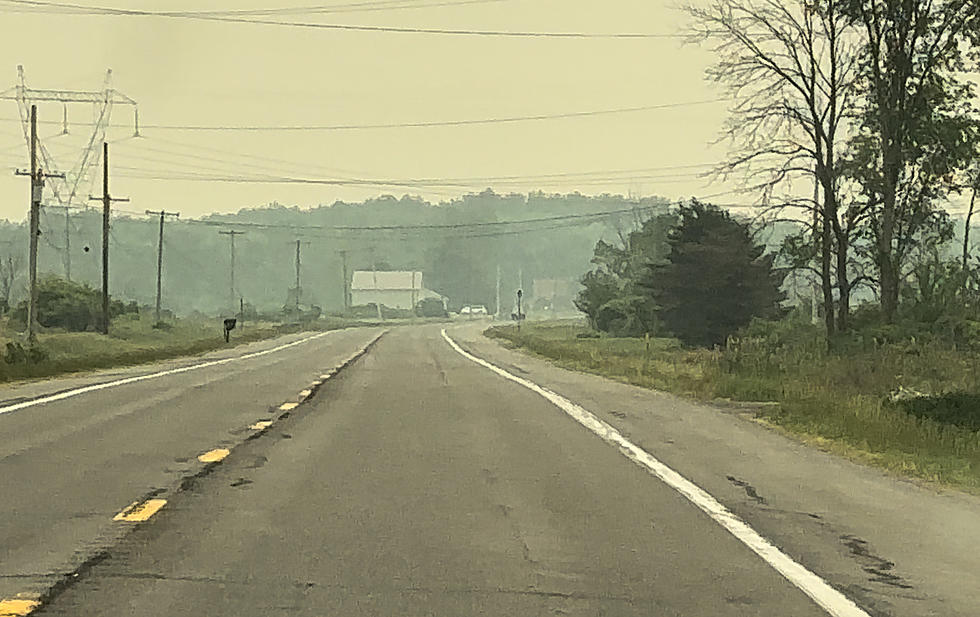
(Updated Tuesday, 5:00 a.m.) The Department of Environmental Conservation has extended an air quality health alert until 12:00 Midnight on Tuesday because of particles in the air. The DEC says the fine particles come from Canadian wildfires in Saskatchewan and Manitoba, causing a hazy sky and air quality alerts.
As of 5 p.m. on Monday, the Greater Utica-Rome area had a moderate reading of 54 PM 2.5.
According to the DEC:
The pollutant of concern is: Fine Particulate Matter
The advisory is in effect 10 a.m. through 11:59 p.m.
The Air Quality Health Advisory regions consist of: Eastern Lake Ontario, which includes northern Cayuga, Jefferson, Monroe, Oswego, and Wayne counties; Central New York, which includes Allegany, Broome, southern Cayuga, Chemung, Chenango, Cortland, Delaware, southern Herkimer, Livingston, Madison, Onondaga, Oneida, Ontario, Otsego, Tioga, Tompkins, Schuyler, Seneca, Steuben, and Yates; and Western New York, which includes Cattaraugus, Chautauqua, Erie, Genesee, Niagara, Orleans, and Wyoming counties.
DEC and DOH issue Air Quality Health Advisories when DEC meteorologists predict levels of pollution, either ozone or fine particulate matter (PM2.5), are expected to exceed an Air Quality Index (AQI) value of 100. The AQI was created as an easy way to correlate levels of different pollutants to one scale, with a higher AQI value indicating a greater health concern.
Fine Particulate Matter
Fine particulate matter (PM) consists of tiny solid particles or liquid droplets in the air that are 2.5 microns or less in diameter. PM 2.5 can be made of many different types of particles and often come from processes that involve combustion (e.g., vehicle exhaust, power plants, and fires) and from chemical reactions in the atmosphere.
The DEC says the small particle pollutants can cause short term health effects and residents should limit their activity outdoors during the alert.
"Exposure can cause short-term health effects, such as irritation to the eyes, nose, and throat, coughing, sneezing, runny nose, and shortness of breath. Exposure to elevated levels of fine particulate matter can also worsen medical conditions such as asthma and heart disease. People with heart or breathing problems, and children and the elderly may be particularly sensitive to PM 2.5."
Spectacular 2025 Boilermaker Photos
Gallery Credit: Nancy L. Ford Photography and Camden J Tucker
Albany Symphony in Utica's Harbor Point
Gallery Credit: NANCY L. FORD
Photos of the most severe damage in Clark Mills, NY from the Tornado on June 22, 2025
Gallery Credit: Nancy L. Ford
More From WIBX 950